
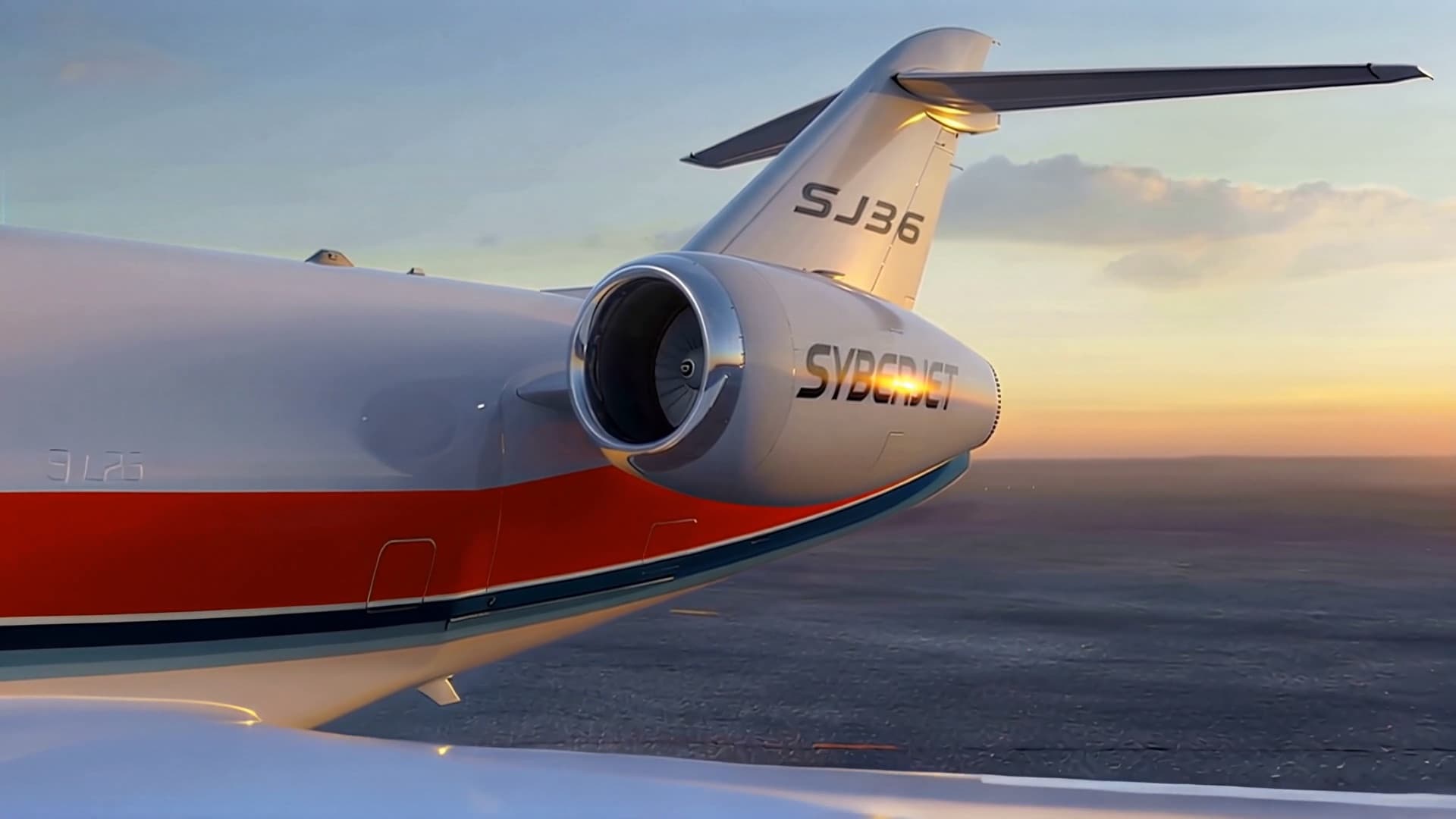
SJ36 // Powerplant
Williams International FJ44-4A
Two rear-mounted turbofans. Field-mature, FADEC-controlled, 5,000 hours between overhauls.
These are projected numbers.
Powerplant comparison // FJ44 family
The most powerful FJ44
Every certificated FJ44 model on one chart. The FJ44-4A that powers the SJ36 sits at the top of the family; the FJ44-2A flies on the SJ30 today. Switch the measure to see where each one wins.
Takeoff rating (5 minutes) and dry weight from the EASA type certificate data sheet. Dry weight excludes starter and generator.
Live thrust report // Aircraft thrust-to-weight
Thrust for every pound
Drag the aircraft weight. Static takeoff thrust divided by weight is the simplest measure of how hard an aircraft can accelerate and climb — the SJ36 carries more thrust per pound at every weight.
2 × FJ44-4A · 7,242 lbf · max ramp 18,500 lb
2 × FJ44-2A · 4,600 lbf · MTOW 13,950 lb
Side by side
FJ44-4A against FJ44-2A
The SJ36 engine against the one proven on the SJ30. Figures per engine.

FJ44-4A
- Takeoff thrust (5 min)3,621 lbf +57%
- Flat rated to26.1°C (79°F)
- Maximum continuous3,443 lbf +50%
- Dry weight670 lb +26%
- Thrust-to-weight5.40 : 1 +24%
- Overall length68.6 in
- Overall height32.3 in
- Engine controlDual-channel FADEC
- Max N1 (fan)17,139 rpm
- Max N2 (core)37,773 rpm
- Takeoff ITT limit855°C
- EASA type certificate18 May 2011

FJ44-2A
- Takeoff thrust (5 min)2,300 lbf
- Flat rated to22.2°C (72°F)
- Maximum continuous2,300 lbf
- Dry weight530 lb
- Thrust-to-weight4.34 : 1
- Overall length59.8 in
- Overall height29.6 in
- Engine controlElectronic fuel control
- Max N1 (fan)18,150 rpm
- Max N2 (core)40,700 rpm
- Takeoff ITT limit820°C
- EASA type certificate9 Jul 2001
Support model
Built to stay on wing
Williams International backs the FJ44 with a 5,000-hour overhaul interval and a hot-section inspection that can usually be done without removing the engine.
Powerplant architecture
Inside the FJ44
A twin-spool turbofan: a single-stage fan and axial compressor on the low-pressure spool, a centrifugal compressor on the high-pressure spool, an annular combustor and a full-length bypass duct with exhaust mixer. Hover or tap a part.
- 01Composite inletThe FJ44-4A introduced a composite inlet over the FJ44-3A it is scaled from.
- 02Single-stage fanOne wide fan stage drives most of the thrust through the full-length bypass duct.
- 03Axial IP compressorAxial intermediate-pressure stages behind the fan, aerodynamically improved on the -4A.
- 04Centrifugal HP compressorA single centrifugal stage delivers the final pressure rise into the combustor.
- 05Annular combustorA single annular combustion chamber around the core shaft.
- 06HP turbineA single stage drives the centrifugal compressor on the high-pressure spool (N2).
- 07LP turbineTwo stages drive the fan and IP compressor on the low-pressure spool (N1).
- 08Exhaust mixerMixes hot core flow with cool bypass air before the nozzle.
- 09Dual-channel FADECFull-authority digital engine control, two independent channels.
Powerplant logic
What it means in the cockpit
Architecture
Twin-spool turbofanEngine control
Dual-channel FADECFlat rating
Full thrust to 79°FInstallation
Rear-mounted pairInlet
CompositeExhaust
Forced mixerOverhaul
5,000 hr TBOHot section
2,500 hr, on wingOperating limits // FJ44-4A
The numbers on the gauges
Takeoff limits. The FADEC holds the engine inside them, so the pilot flies a thrust lever, not a set of temperatures.
Sources: EASA Type-Certificate Data Sheet IM.E.016, Williams International FJ44/FJ33 series, issue 13 (21 July 2021); Williams International FJ44 overhaul-interval announcement (5,000 hr TBO, 2,500 hr hot-section inspection). Combined SJ36 thrust is two installed FJ44-4A engines at the engine's takeoff rating. These are projected numbers; installed thrust may differ.
SJ36 powerplant